 Ghazi University

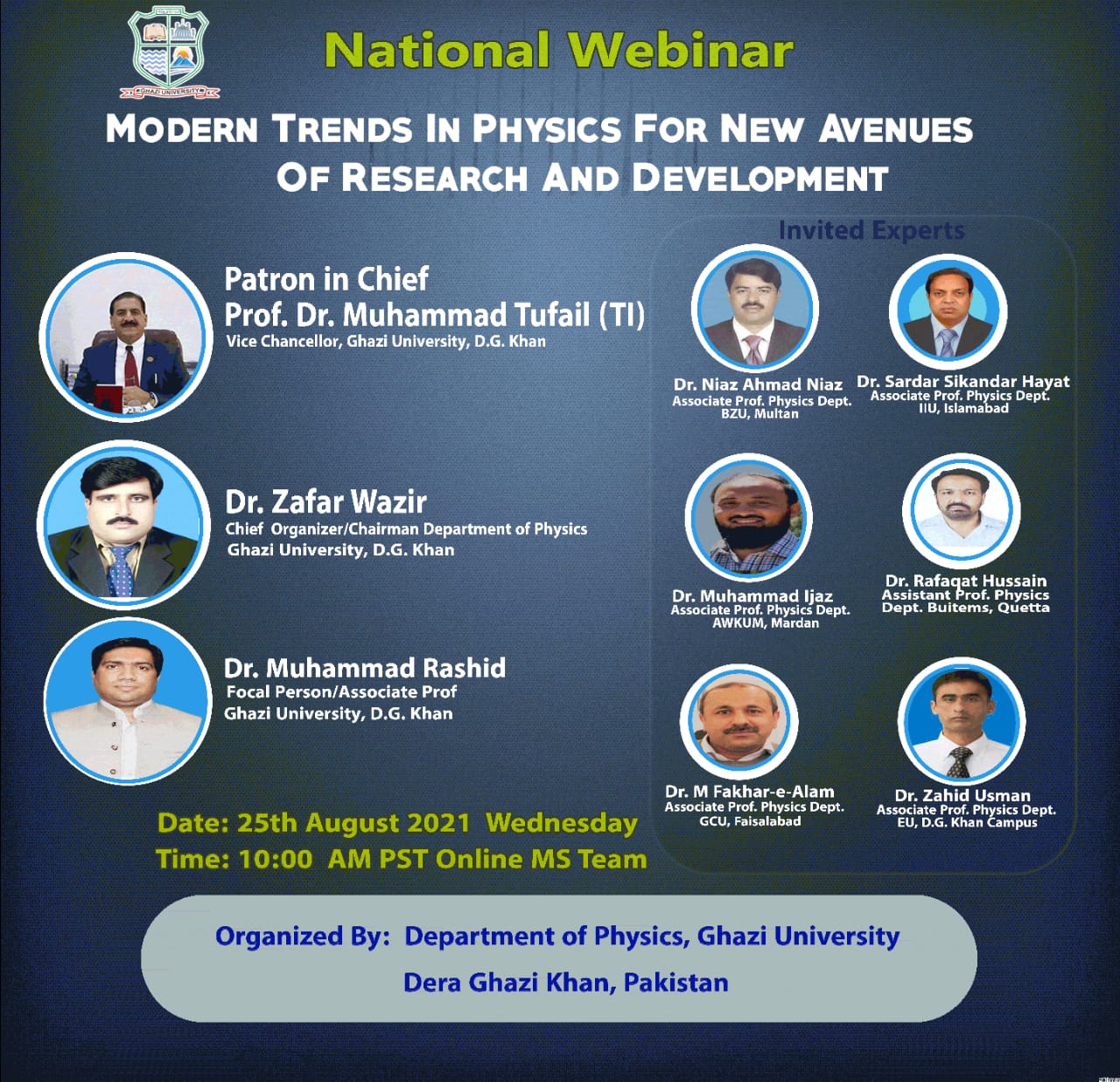
The purpose of the national webinar is to provide a platform that would enable scientists, teachers, researchers and students to interact and share ideas, thoughts and scientific findings in all areas of Physics, including Condensed matter and Materials Physics, Laser and Plasma Physics, Nuclear Physics, Computational Physics, High Energy Physics. Physics is increasingly important for broad technological and economic development. It has long been a fertile ground for the development of technology. At the beginning of the 21st century, physics has become more important for the other sciences, enabling progress in materials science, astronomy, chemistry, geology, and the biomedical sciences. Many of the problems in these areas are increasingly becoming physicsdependent problems; that is, the basic laws of physics play an important role in their understanding. New areas in physics are emerging in response to experimental techniques of unprecedented scope and sensitivity as well as the increasing power of computation. We can now control single atoms, observe properties of matter at densities greater than that of the atomic nucleus, design materials with novel properties, study the molecular motors responsible for distributing genetic information during cell division, and probe the earliest moments of the universe. Energy storage devices have found great applications in many portable devices. Hence, the eco-friendly materials replace the conventional acid battery metallic storage devices that require more recharge time, acid utilization and have less abundance. Energy storage devices are systems which store energy in various forms such as electrochemical, kinetic, pressure, potential, electromagnetic, chemical, and thermal; using, for example, fuel cells, batteries, capacitors, flywheels, compressed air, pumped hydro, super magnets, hydrogen, etc. Energy storage devices can play an important role in stand-alone renewable power systems. In systems without generators, they can provide backup power for intermittent renewable power sources. In systems with generators, they can save fuel and help avoid inefficient generator operation by serving the load during times of low electric demand, where the generator is least efficient.